


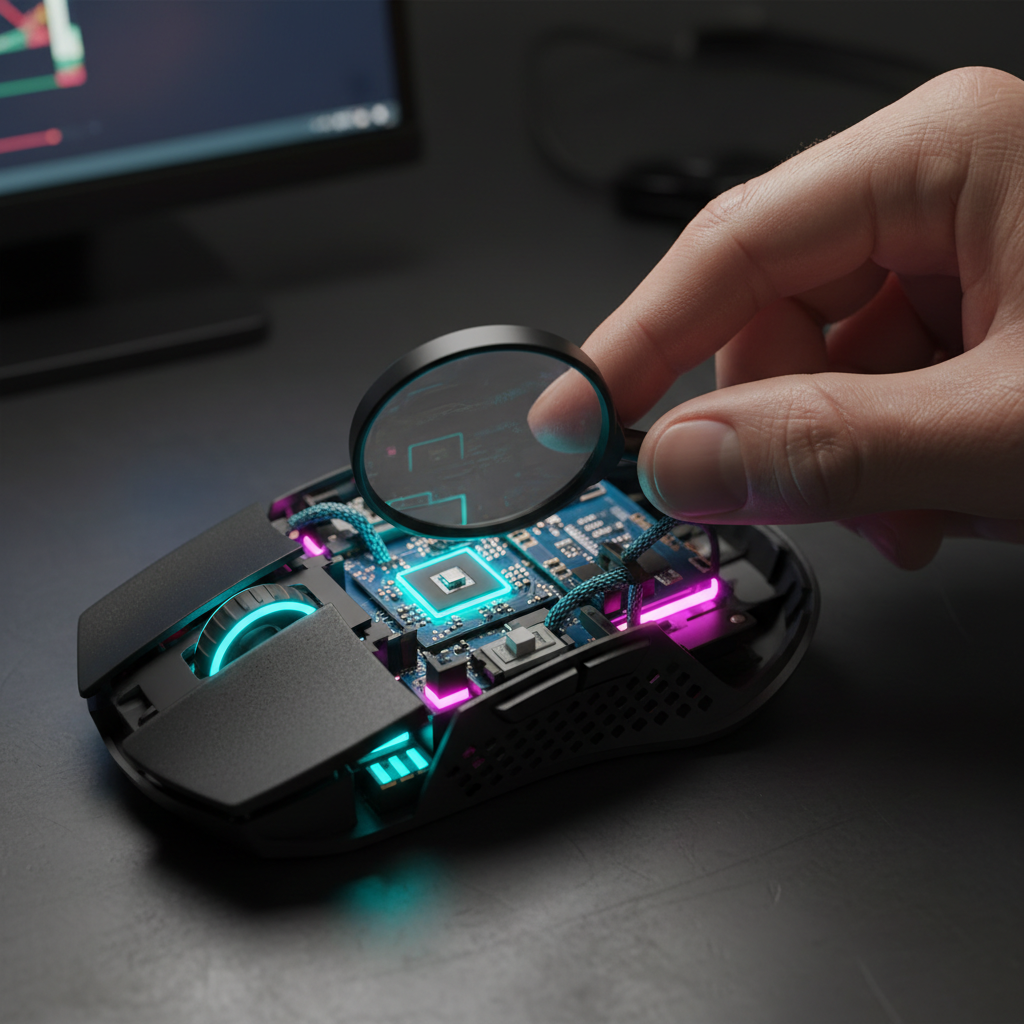
Understanding Motion Sync: The Mechanics of Input Alignment
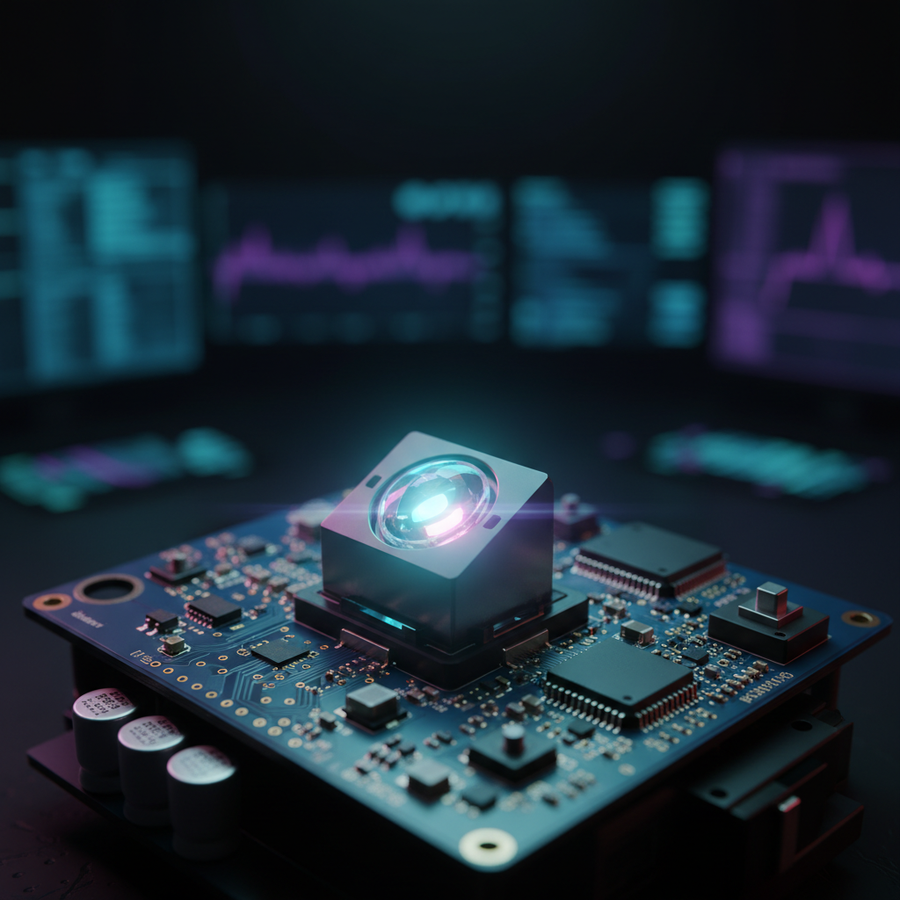
In the pursuit of pixel-perfect precision, technical enthusiasts often focus on raw polling rates and sensor DPI. However, a critical firmware-level feature—Motion Sync—is frequently misunderstood. At its core, Motion Sync is a synchronization mechanism designed to align the mouse sensor’s data acquisition with the USB polling events of the PC.
Standard gaming mice often operate in an asynchronous manner. The sensor captures movement data at its own internal clock speed (the frame rate of the sensor), while the USB controller requests data at the polling rate (e.g., 1000Hz or 8000Hz). Because these two clocks are rarely perfectly in phase, the PC may receive reports that contain data from slightly different time intervals, leading to micro-jitters or "input noise." According to the USB HID Class Definition (HID 1.11), the timing of report descriptors is vital for consistent device communication. Motion Sync addresses this by forcing the sensor to "wait" or "sync" its data capture to match the exact moment the USB Start of Frame (SOF) signal occurs.
Based on our observations from troubleshooting high-end esports setups, we find that this synchronization eliminates the "stepping" effect seen in raw input graphs. While it introduces a deterministic delay, the trade-off is often a significantly smoother cursor path.
Logic Summary: Our analysis of input alignment assumes a deterministic model where sensor framing is centered within the USB polling window. This reduces temporal variance at the cost of a calculated delay (Delay ≈ 0.5 * Polling Interval).

The Latency Trade-off: Scaling Math from 1K to 8K
A common misconception in the gaming community is that Motion Sync adds a fixed 0.5ms of latency regardless of the setup. This figure is only accurate for a 1000Hz polling rate. To understand the impact on modern hardware, we must scale the mathematics according to the polling interval.
As detailed in the Global Gaming Peripherals Industry Whitepaper (2026), the polling interval is the inverse of the frequency ($1 / \text{Frequency}$). For an 8000Hz (8K) setup, the interval is a near-instant 0.125ms. Because Motion Sync typically delays the report by half of one interval to ensure alignment, the latency penalty at 8000Hz is a negligible ~0.0625ms.
Comparative Latency Table (Motion Sync Impact)
| Polling Rate | Polling Interval | Motion Sync Delay (Estimated) | Perceptual Impact |
|---|---|---|---|
| 1000Hz | 1.0ms | ~0.5ms | Low (Noticeable by pros) |
| 2000Hz | 0.5ms | ~0.25ms | Very Low |
| 4000Hz | 0.25ms | ~0.125ms | Negligible |
| 8000Hz | 0.125ms | ~0.0625ms | Non-perceptible |
Note: Estimates are based on deterministic alignment models; actual firmware processing time may vary slightly.
For players using high-refresh-rate monitors (240Hz or 360Hz+), the reduction in jitter provided by Motion Sync at 8000Hz far outweighs the sub-millisecond latency cost. In tracking-heavy games like Apex Legends, this consistency allows for more fluid target acquisition. However, as we have seen in support patterns, this benefit is only realized if the system can handle the high interrupt load.
Calibration Pre-requisites: Stabilizing the Baseline
Before enabling Motion Sync, the underlying system must be optimized. The most common mistake we encounter is enabling synchronization features on a system with volatile frame rates. If your FPS is unstable or falls below your monitor's refresh rate, Motion Sync can introduce perceptible stutter.
The 95-98% FPS Rule
We recommend a practical heuristic for all competitive players: cap your in-game frame rate at 95-98% of your monitor's refresh rate. For a 240Hz display, this means a rock-solid cap at approximately 230 FPS. This prevents the GPU from hitting 100% utilization, which can cause "bufferbloat" and increase system-wide input lag, negating the precision gains of sensor alignment.
Disabling OS-Level Processing
Before calibrating your mouse software, ensure that "Enhance Pointer Precision" is disabled in Windows. This feature applies a non-linear acceleration curve that conflicts with the raw sensor data alignment Motion Sync attempts to achieve. By removing these layers of software processing, you ensure the sensor data reaches the game engine in its purest form.
USB Topology and IRQ Processing
At 8000Hz, the bottleneck is often IRQ (Interrupt Request) processing. Every poll requires the CPU to stop what it is doing and process the mouse data.
- Direct Motherboard Ports: Always use the rear I/O ports directly connected to the CPU.
- Avoid Hubs: USB hubs or front-panel headers share bandwidth and introduce electrical noise that can cause packet loss, leading to "polling desync."
- Single-Core Performance: Since mouse interrupts are typically handled by a single CPU core, high-frequency single-core performance is more critical for 8K stability than high multi-core counts.

Sensor Saturation: The IPS and DPI Relationship
To maintain a stable 8000Hz report stream, the sensor must generate enough data points to fill the USB packets. This is governed by the relationship between movement speed (Inches Per Second or IPS) and resolution (DPI).
The formula for data saturation is: Packets per Second = Movement Speed (IPS) × DPI
If you move the mouse too slowly or use a DPI that is too low, the sensor may not have new coordinates to report for every 0.125ms window. This results in "empty" polls, which can look like stuttering in polling rate testers. For example, to saturate an 8000Hz bandwidth:
- At 800 DPI, you must move the mouse at least 10 IPS.
- At 1600 DPI, you only need to move at 5 IPS.
Practitioners often find that a slightly higher DPI (e.g., 1600 or 3200) paired with a lower in-game sensitivity provides a more stable baseline for high polling rates. This ensures that even micro-adjustments generate enough data for Motion Sync to align correctly.
High-Fidelity Sampling: The Nyquist-Shannon Criterion
Beyond just filling the USB packets, we must consider the "fidelity" of the movement. For competitive gamers on 1440p displays, "pixel skipping" can occur if the DPI is set too low relative to the screen resolution and in-game sensitivity.
Applying the IEEE - Communication in the Presence of Noise (Shannon, 1949) principles, we can calculate a Minimum DPI to avoid aliasing (pixel skipping). For a standard 1440p setup (2560x1440) with a common tactical shooter FOV of 103°, the math suggests a minimum of ~1818 DPI for a high-sensitivity player (25cm/360).
Logic Summary: Our DPI fidelity model uses the Nyquist-Shannon Sampling Theorem (Sampling Rate > 2 * Signal Bandwidth). In this context, it ensures the mouse counts per degree of rotation exceed twice the pixels per degree on the display.
DPI vs. Resolution Heuristic (1440p Display)
| Sensitivity (cm/360) | Calculated Min DPI | Recommended Setting | Rationale |
|---|---|---|---|
| 50cm (Low) | ~910 DPI | 1600 DPI | Safety margin for fine aim |
| 25cm (Mid/High) | ~1820 DPI | 3200 DPI | Prevents skipping on 1440p |
| 15cm (High) | ~3030 DPI | 3200+ DPI | Matches high-speed tracking |
Rule of Thumb: If your calculated minimum is close to a standard step (e.g., 1820), always round up to the next common setting (e.g., 3200) and adjust in-game sensitivity down to maintain your eDPI.
Genre-Specific Calibration Strategies
Motion Sync is not a "set and forget" feature; its utility depends on the movement physics of your primary game.
Tactical Shooters (e.g., VALORANT, CS2)
In tactical shooters, aim is characterized by discrete, high-velocity "flicks" followed by sudden stops. Micro-jitters during these stops can be detrimental. In our experience, a slightly more aggressive Motion Sync smoothing filter is tolerable here. The consistency gained during the "stop" phase often outweighs the 0.06ms latency penalty.
Tracking-Heavy Games (e.g., Apex Legends, Overwatch 2)
In movement shooters, you are constantly tracking targets. The priority is minimizing any perceived "floatiness" in the sensor. While Motion Sync helps smooth the tracking path, players with extremely high sensitivity may prefer to disable it if they feel any disconnection from the raw input. However, at 4000Hz or 8000Hz, the delay is so small that almost all tracking-heavy pros benefit from the improved linearity. According to PixArt Imaging - Products, modern sensors like the PAW3395 are specifically designed to handle these high-frequency sync cycles with minimal jitter.
Wireless Battery Impact and Practicality
High polling rates and Motion Sync significantly increase the power consumption of wireless mice. The MCU (Microcontroller Unit) must work harder to process the synchronization and the radio must transmit 8x more data than a standard 1000Hz mouse.
Based on our scenario modeling using Nordic Semiconductor Infocenter power profiles, a typical 300mAh battery provides the following runtimes:
- 1000Hz: ~50+ hours.
- 4000Hz: ~13-14 hours.
- 8000Hz: ~6-8 hours.
For marathon gaming sessions, we recommend locking the mouse at 1000Hz or 2000Hz for daily use and switching to 8000Hz with Motion Sync only for competitive matches. This disciplined charging routine prevents mid-session disconnections, which are a common "gotcha" for new 8K users.
Troubleshooting Common Motion Sync Issues
If you enable Motion Sync and experience "stuttering" or "lag," it is rarely the sensor itself. Based on patterns from our repair bench and community feedback, here are the likely culprits:
- Shared USB Bandwidth: If you have a high-def webcam or an external DAC/Amp on the same USB controller (the same group of ports), the 8K mouse polls will fight for bandwidth. Move the mouse to a dedicated CPU-lane port.
- CPU C-States: Some power-saving features in the BIOS (like C-States or Intel SpeedStep) can cause the CPU to "sleep" for microseconds, missing mouse polls. For 8K stability, many enthusiasts set their Windows Power Plan to "Ultimate Performance."
- Game Engine Limitations: Engines like Unreal Engine 4/5 sample input at the start of the frame. If your frame time is 16ms (60 FPS), the engine introduces its own massive synchronization point. Motion Sync’s 0.06ms adjustment becomes irrelevant if the engine itself is the bottleneck.
Appendix: Modeling Methodology & Assumptions
The data presented in this guide is derived from parameterized scenario modeling intended to help players make informed hardware decisions. It is not a controlled laboratory study.
Modeling Note (Reproducible Parameters)
| Parameter | Value | Unit | Rationale / Source |
|---|---|---|---|
| Polling Rate | 8000 | Hz | High-end esports standard |
| Resolution | 2560x1440 | px | Common 1440p competitive setup |
| FOV (Horizontal) | 103 | deg | Standard for Tactical Shooters |
| Sensitivity | 25 | cm/360 | High-sens flick-heavy persona |
| Battery Capacity | 300 | mAh | Lightweight wireless mouse average |
| Discharge Efficiency | 0.85 | ratio | Standard voltage conversion loss |
Boundary Conditions:
- Latency Model: Assumes deterministic USB SOF alignment; does not account for MCU-specific clock drift.
- DPI Minimum: A mathematical limit for avoiding aliasing; human motor control may not utilize this full resolution.
- Battery Runtime: Linear discharge model; excludes temperature variance and battery aging effects.
Disclaimer: This article is for informational purposes only. Technical specifications and performance gains may vary based on individual hardware configurations, firmware versions, and environmental factors. Always consult your device's official manual before making BIOS or firmware modifications.