


The Microscopic Violence of a Keypress: Understanding Contact Physics
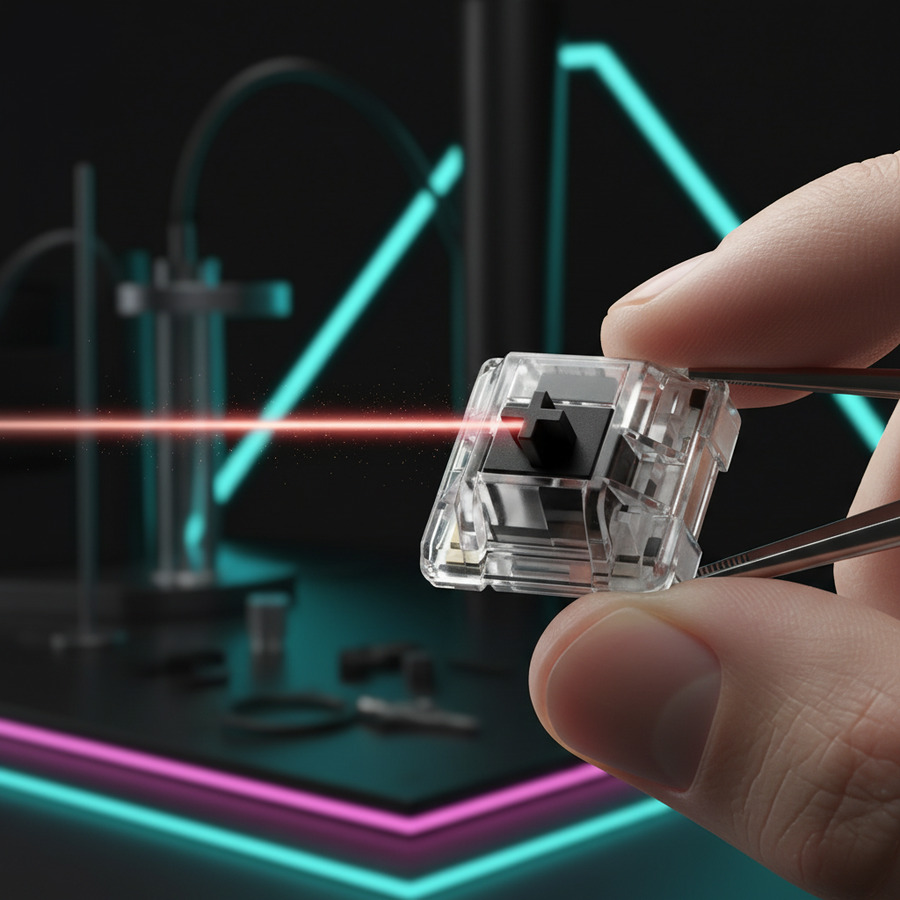
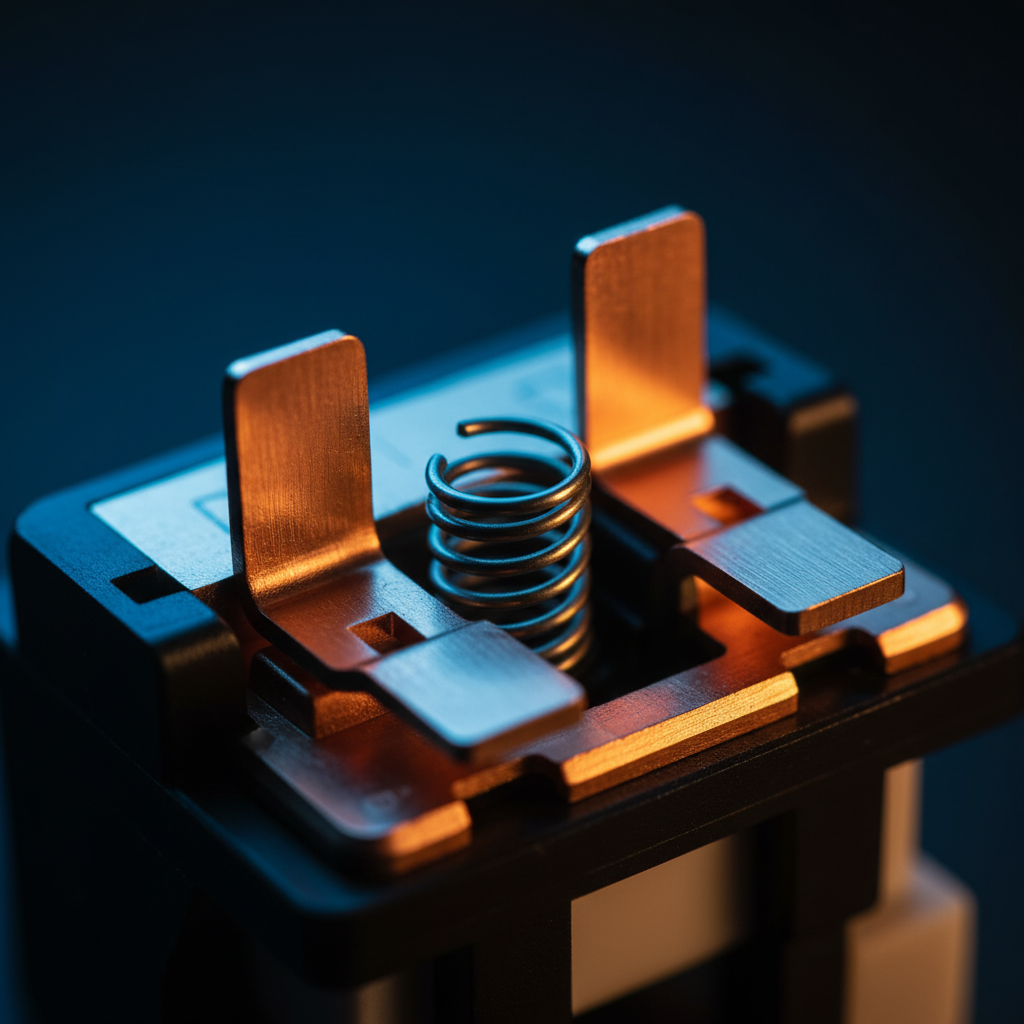
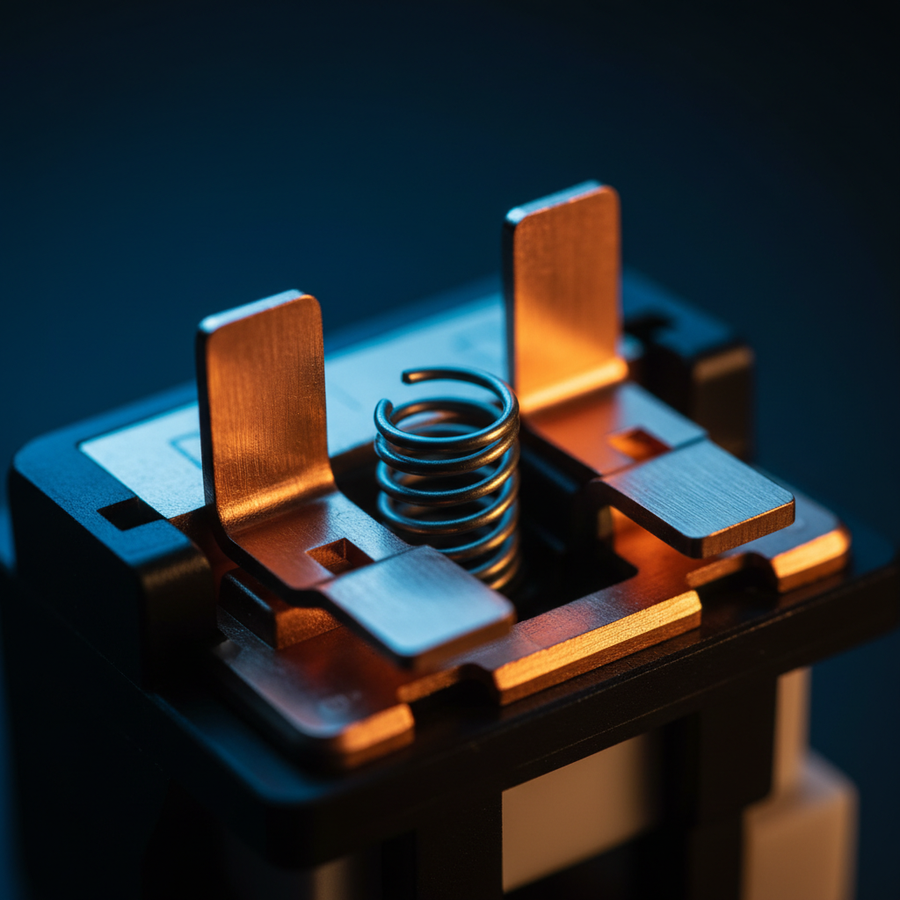
When a user initiates a keystroke, the perceived experience is one of smooth, linear travel ending in a tactile "click" or bottom-out. However, at the electrical level, the event is significantly more chaotic. The "Physics of Bounce" refers to the unavoidable mechanical oscillation that occurs when two metallic surfaces collide. In a standard mechanical switch, a copper alloy leaf is forced against a stationary contact point. Because these materials possess elasticity, they do not simply meet and stay together; they rebound, vibrate, and strike each other multiple times before settling into a stable closed state.
This phenomenon, known as contact bounce or "chatter," typically occurs within a window of 1ms to 20ms (based on material properties and switch age). For a modern microcontroller (MCU) polling at high frequencies, these microscopic rebounds appear as a rapid-fire sequence of "on" and "off" signals. Without a sophisticated digital filter—known as a debounce algorithm—a single intentional press would be registered by the computer as five, ten, or even twenty distinct inputs.
Engineering a high-performance peripheral requires a deep understanding of this spring-mass-damper system. According to the Global Gaming Peripherals Industry Whitepaper (2026), the integrity of the input signal is the foundational metric for competitive-grade hardware. To maintain this integrity, firmware must act as a biological necessity, translating the violent physics of metal leaves into the clean, singular logic required by software.
The Mechanics of the Metal Leaf: Why Rebound is Inevitable
The internal architecture of a mechanical switch is essentially a study in kinetic energy management. The moving contact, often referred to as the "leaf," acts as a cantilever spring. When the switch stem descends, it either releases the leaf to strike the contact or pushes it directly.
The Spring-Mass-Damper Model
Every mechanical switch can be modeled as a spring-mass-damper system. When the leaf strikes the contact, the kinetic energy must be dissipated.
- Mass: The weight of the copper leaf.
- Spring Constant: The stiffness of the metal, which dictates the return force.
- Damping: The internal friction of the metal and the surrounding air, which eventually stops the vibration.
Because the damping factor in most high-conductivity copper alloys is relatively low, the "bounce" is prolonged. A high-quality, new switch might settle in under 5ms, but as the metal undergoes work-hardening and the contact surfaces accumulate microscopic oxidation, this settling time can increase significantly.
| Switch Condition | Typical Bounce Duration (ms) | Impact on Signal |
|---|---|---|
| Factory New (Premium) | 1ms – 3ms | Minimal filtering required; very stable. |
| Standard Grade | 5ms – 8ms | Requires moderate debounce to prevent chatter. |
| Worn / Aged | 10ms – 20ms+ | High risk of "double-clicking" or missed inputs. |
| Hall Effect (Magnetic) | 0ms | No physical contact; zero mechanical bounce. |
Logic Summary: These ranges are estimated based on common industry heuristics and data from The Engineer's Guide to Switch Contact Debounce Techniques.

Firmware Intervention: The Digital Sieve
To solve the bounce problem, firmware developers implement "Debounce Logic." This is a software filter that instructs the MCU to ignore signal changes that occur too rapidly to be human-initiated. There are two primary schools of thought in debounce design, each representing a different trade-off between speed and stability.
1. Defer-Type Debouncing (Stability First)
In a defer-type system, the firmware waits for the signal to stay stable for a set period (e.g., 5ms) before reporting the press to the computer. While this is the safest method to prevent unintended inputs, it adds a mandatory latency penalty equal to the debounce window. For a gamer, a 10ms defer filter means their action is delayed by 10ms (based on standard firmware polling cycles).
2. Eager-Type Debouncing (Speed First)
Eager debouncing reports the very first "strike" of the metal leaf to the computer immediately, providing a near-instant response. However, the firmware then "locks" the input for a set duration (the lockout period) to ignore the subsequent bounces. While faster, this method can be more susceptible to electrical noise and requires high-quality hardware to ensure the first strike is actually a valid press.
According to the USB HID Class Definition, the way these reports are structured is critical for OS compatibility. Advanced firmware often uses "Symmetrical Eager" debouncing, which applies this logic to both the press and the release of the key, ensuring the lowest possible latency in both directions—a critical factor for games requiring rapid "counter-strafing."
The 8000Hz Paradigm: Why Polling Rates Change the Math
As the industry moves toward 8000Hz (8K) polling rates, the relationship between mechanical bounce and electronic latency becomes even more strained. At 1000Hz, the computer checks for updates every 1.0ms. At 8000Hz, that interval drops to a staggering 0.125ms.
The Math of 8K Performance
- Polling Interval: 1 / 8000 = 0.125ms.
- Motion Sync Latency: In high-performance sensors, Motion Sync adds a delay equal to half the polling interval. At 8K, this is a negligible ~0.0625ms, compared to the 0.5ms delay seen at 1000Hz.
However, 8000Hz creates a massive influx of data. If a mechanical switch is bouncing for 5ms, an 8K MCU will see 40 individual "check-ins" during that single bounce event. This places an immense load on the system's CPU, specifically regarding IRQ (Interrupt Request) processing. To saturate the 8000Hz bandwidth effectively, users must also consider their sensor settings. For example, to provide enough data packets at 800 DPI, a user must move the device at 10 IPS (Inches Per Second). However, at 1600 DPI, only 5 IPS is required to maintain a saturated 8K stream.
This high-frequency environment makes "dirty" mechanical signals even more problematic. If the debounce logic isn't perfectly tuned, the system may struggle with packet loss or inconsistent frame times, leading to what feels like "micro-stutter" in-game.

The Hall Effect Revolution: Eliminating the Filter
The most significant advancement in overcoming the physics of bounce is the shift toward Hall Effect (HE) Magnetic Switches. Unlike mechanical switches, HE switches do not rely on physical metal-to-metal contact. Instead, a magnet moves toward a sensor that measures the strength of the magnetic field.
Because there is no physical collision, there is zero mechanical bounce. This allows the firmware to eliminate the fixed debounce timer entirely. In its place, HE keyboards use "Rapid Trigger" technology, which relies on continuous position sampling.
Latency Comparison: Mechanical vs. Hall Effect
We modeled a scenario for a Competitive Rhythm Gamer to calculate the real-world latency advantage of moving from a worn mechanical switch to a Hall Effect system with Rapid Trigger.
| Parameter | Mechanical (Worn) | Hall Effect (RT) | Rationale |
|---|---|---|---|
| Travel Time | 5ms | 5ms | Standard 150mm/s finger velocity. |
| Debounce Filter | 15ms | 0.2ms | Fixed timer vs. sensor processing overhead. |
| Reset/Hysteresis | 3.3ms | 0.3ms | 0.8mm mechanical reset vs. 0.05mm RT reset. |
| Total Latency | ~23.3ms | ~5.5ms | Calculated end-to-end input delay. |
Modeling Note: This is a scenario-based model, not a controlled lab study. It assumes a finger-lift velocity of 150mm/s and a worn mechanical switch with a 15ms debounce window.
The resulting ~18ms advantage for the Hall Effect system is transformative for timing-critical genres. In a rhythm game at 180 BPM, an 18ms delta represents roughly 20% of the total hit window for a "Perfect" score. By removing the "dead travel" of mechanical hysteresis and the artificial delay of debounce filters, Hall Effect technology provides an analog-like response that mechanical leaves simply cannot match.
System-Level Bottlenecks and USB Topology
Even the most optimized debounce logic can be undermined by poor system configuration. For devices operating at 4000Hz or 8000Hz, USB Topology is a critical factor.
Devices must be connected directly to the Motherboard Rear I/O ports. Using front-panel headers or unpowered USB hubs introduces shared bandwidth and potential signal interference, which can lead to packet drops. Furthermore, 8K polling stresses single-core CPU performance. Users on older processors may find that the overhead of processing 8000 interrupts per second actually lowers their in-game FPS, negating the latency benefits.
Best Practices for Maintaining Input Integrity
For those using traditional mechanical keyboards, maintaining the "health" of the metal leaves is essential for minimizing the need for aggressive (and slow) filtering.
- Switch Selection: Prioritize switches with gold-plated cross-points. Gold is highly resistant to oxidation, ensuring the "settling time" of the bounce remains low over the switch's lifespan.
-
Firmware Tuning: If using open-source firmware like QMK, experiment with
DEBOUNCE_TYPE = sym_eager. This provides the fastest possible response, provided your switches are in good condition. - Environmental Control: Dust and humidity are the enemies of mechanical contacts. According to UK OPSS Safety Alerts, electronic degradation often stems from environmental contaminants. Using a dust cover when the keyboard is not in use can extend the "clean" signal life of your switches.
- The "Double-Input" Test: If a key begins to chatter (registering two presses for one), it is a sign that the physical bounce has exceeded the firmware's debounce window. Before increasing the debounce time (which adds latency), try cleaning the switch with specialized electronic contact cleaner.
The Future of the Filter
The physics of bounce is a fundamental constraint of mechanical engineering that electronics have spent decades trying to "fix" with software. While debounce algorithms have become incredibly sophisticated—using statistical sampling to cover the 99th percentile of bounce events—the ultimate solution lies in the removal of the contact itself.
As Hall Effect technology becomes more accessible, the "Digital Sieve" of the debounce filter will likely become a relic of the past. For the modern enthusiast, understanding the microscopic violence of the metal leaf is the first step in appreciating the silent, magnetic precision of the next generation of performance gear.
Disclaimer: This article is for informational purposes only. Modifying keyboard firmware or opening electronic devices may void warranties. Always refer to your manufacturer's specific guidelines before making hardware adjustments.