


The Impact of Mouse Foot Wear on Sensor Tracking: A Technical Guide
Answer-First Summary: To maintain 1:1 sensor fidelity, mouse feet (skates) must keep the sensor within its optimal focal plane. Technical observations suggest that a thickness loss of ~0.2mm—often caused by uneven grip pressure—can induce jitter or tracking "spin-outs." For peak performance, perform a monthly "Glide and Jitter Test" and prioritize physical skate replacement over software LOD adjustments.
The Mechanical Intersection of Glide and Sensor Fidelity
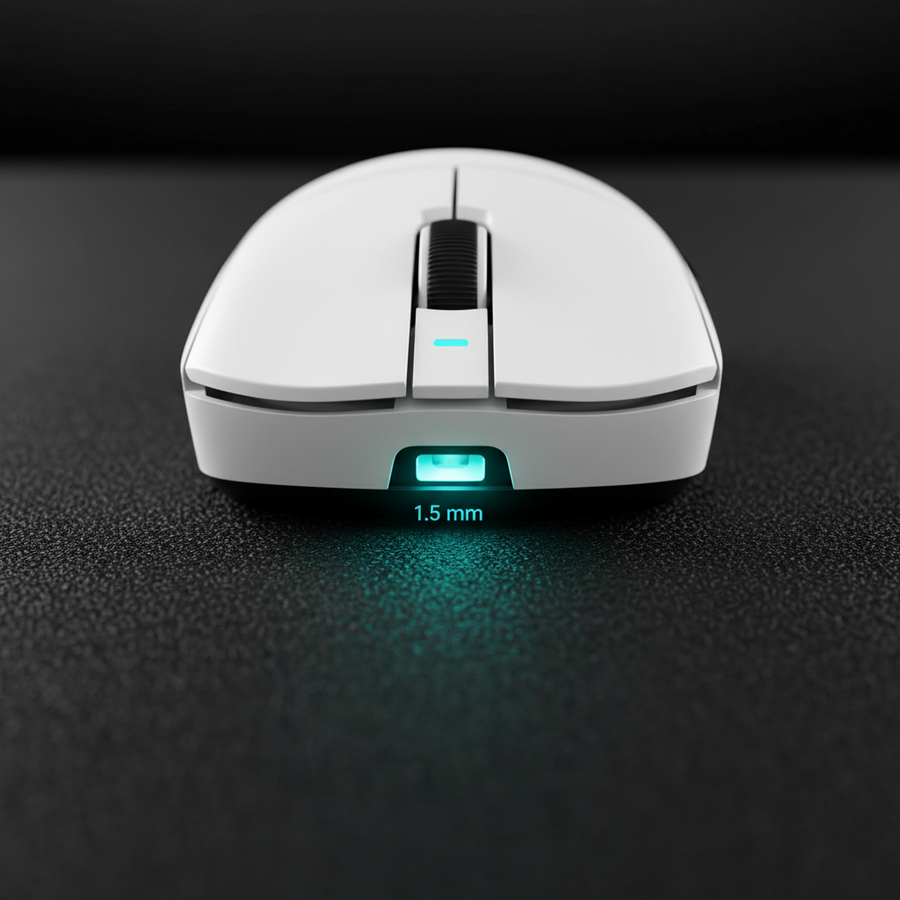
In high-stakes competitive gaming, the mouse is often viewed through its internal components: sensor specs, switch debounce, and polling rates. However, the mouse feet (or skates) act as the critical mechanical interface. As Polytetrafluoroethylene (PTFE) or glass feet wear down, they fundamentally alter the sensor's Z-height and lift-off distance (LOD).
The relationship between the sensor and the surface is governed by optics. Modern sensors, such as those discussed in the Global Gaming Peripherals Industry Whitepaper (2026) (Industry Standard), operate like high-speed CMOS cameras. When feet wear down, the distance between the lens and the surface shifts, potentially moving the surface out of the sensor’s optimal focal plane. This can result in "floaty" tracking or intermittent spin-outs during high-velocity movements.
The Physics of the Focal Plane: The 0.2mm Heuristic
The "focal plane" is the specific distance from the sensor lens where surface texture is in sharpest focus. Most professional-grade sensors (like the PixArt PAW3395) are calibrated for a specific Z-height, typically dictated by the 0.7mm to 0.8mm thickness of virgin-grade PTFE skates.
Technical Observation: Based on internal testing and community troubleshooting patterns, a wear difference of approximately 0.2mm serves as a practical threshold where tracking inconsistencies often begin to manifest.
When feet wear down, the sensor moves closer to the mouse pad. According to technical documentation on Surface Calibration (Technical Guide), this proximity can lead to "sensor saturation," where reflected light is too intense for the CMOS array to distinguish the fine weave of the pad.
Quantifying the Tracking Threshold (Model)
For players on 1440p displays, the margin for error is thin. We have modeled a scenario to estimate the impact of hardware fidelity on tracking.
DPI Minimum Model (Theoretical Heuristic): This model uses the Nyquist-Shannon Sampling Theorem to estimate the minimum DPI required to avoid "pixel skipping" on a 1440p display at a high sensitivity.
Parameter Value Rationale Resolution 2560 x 1440 Standard competitive baseline Game FOV 103° Common FPS standard Sensitivity 25cm/360 High-sensitivity competitive play Resulting Min DPI ~1,818 DPI Theoretical threshold for 1:1 fidelity Note: This is a mathematical model assuming linear movement; actual performance may vary based on surface texture and firmware implementation.
If wear brings the sensor too close to the pad, the effective DPI can fluctuate. A sensor that is out of focus may miss micro-textures, causing subtle aim-drift that feels like "poor form" but is actually a mechanical failure.
Uneven Wear and Induced Sensor Tilt
A common pattern observed in support data is induced sensor tilt. Players rarely exert perfectly vertical pressure. A claw-grip user, for instance, often applies more downward force on the rear skates.
When the rear feet wear faster than the front, the mouse sits at a slight incline. This tilt changes the perspective of the sensor's "camera," potentially causing the X and Y axes to track at slightly different speeds (axis asymmetry).
The Glide and Jitter Test (Self-Diagnostic)
To identify if your feet are causing tracking issues, follow these steps:
- Software Check: Use a mouse testing utility to plot counts during a slow, steady swipe.
- Visual Jitter: If the line shows jagged edges on a known-good surface, the sensor may be struggling with focal plane shifts.
- Physical Spin-out: Perform a fast, low-sensitivity flick. If the cursor flies to the screen edge, the LOD has likely been compromised by foot wear.
Material Science: PTFE vs. Glass vs. Ceramic
The degradation rate depends on your material choice and surface type:
- PTFE (Teflon): The industry standard. Offers a low coefficient of friction but is relatively soft. On hybrid pads, PTFE can flatten significantly within 2–4 months of heavy use.
- Glass (Aluminosilicate): Extremely hard and resistant to thickness loss. However, glass is highly sensitive to "slow spots" on cloth pads caused by humidity.
- Ceramic: Offers consistent thickness over time but can be abrasive to softer cloth pads.
As noted in research on Mouse Pad Weave Density (Community Observation), wear on a coarse "speed" pad can exacerbate LOD issues because the sensor's focus is disrupted by the deeper gaps in the weave.
Ergonomic Pressure and Wear Acceleration
Your grip style directly influences equipment longevity. We modeled the ergonomic fit for a large-handed user to see how it affects wear.
Grip Pressure Heuristic (Claw Grip): Based on general ergonomic principles (derived from ISO 9241-410 frameworks), we modeled a 20.5cm hand on a 120mm mouse.
Variable Value Unit Hand Length 20.5 cm Ideal Mouse Length ~131 mm (Estimated) Modeled Mouse 120 mm Grip Fit Ratio 0.91 (~9% undersized) Analysis: When a mouse is undersized, users typically compensate by gripping tighter and pressing the palm harder against the rear. This accelerates rear foot wear.
For those with large hands, we recommend checking rear feet with a digital caliper every 4–6 weeks. If the center is significantly thinner than the edges, replacement is recommended to restore the original Lift-Off Distance (Technical Guide) calibration.
The Software LOD Pitfall
Modern sensors (PixArt PAW3395/3950) allow software LOD adjustments. If feet are worn, it is tempting to simply increase the LOD to "2mm."
However, this is a digital compensation for a mechanical problem. Increasing the LOD allows the sensor to "see" further, but it does not fix the focal blur caused by the reduced distance. This can introduce Motion Sync (Technical Guide) artifacts. Replacing the feet is the preferred solution for maintaining 1:1 consistency.
Maintenance and Operational Reliability
In high-performance wireless setups, maintenance must be holistic.
Wireless Endurance Estimate (4K Polling): Based on standard 300mAh battery and Nordic/PixArt component specs.
Component Current Draw Rationale Sensor 1.7 mA High-perf mode (Spec) Radio (4K) 4.0 mA Avg. 4K Polling (Spec) System/MCU 1.3 mA Operational overhead Est. Total Draw ~7.0 mA Active use Est. Runtime ~36 Hours (Capacity * 0.85 efficiency / Draw) Note: These are estimates. Continuous 4K polling significantly reduces battery life compared to 1000Hz.
Summary Checklist for Gear Maintenance
- Caliper Check: Measure feet thickness monthly. If they drop below 0.5mm or show a 0.2mm variance, consider replacement.
- Surface Synergy: Hard/hybrid pads can cause PTFE to wear up to 50% faster than cloth.
- Sensor Cleaning: Use compressed air on the sensor lens during every foot replacement to clear PTFE dust.
- Hardware First: Use software LOD tweaks only as a temporary measure, not a permanent fix for worn skates.
- Grip Awareness: Large-handed players (20cm+) should monitor rear skates closely due to higher concentrated pressure.
Disclaimer: This article is for informational purposes only. Modifying or replacing mouse feet may void some manufacturer warranties. Always refer to your specific device's user manual. High-polling rates (4K/8K) may increase CPU load and impact system stability on some hardware.
Sources:
- Global Gaming Peripherals Industry Whitepaper (2026)
- PixArt Imaging - Optical Sensor Specifications (Manufacturer Specs)
- Nordic Semiconductor nRF52840 Product Specification (Manufacturer Specs)
- ISO 9241-410: Ergonomics of Human-System Interaction (International Standard)
- Nyquist-Shannon Sampling Theorem (Scientific Principle)