




The 8K Specification Credibility Gap
In the current gaming peripheral market, "8000Hz" or "8K" polling has shifted from a niche enthusiast feature to a standard marketing claim for high-performance mice. However, as specifications escalate, a significant credibility gap has emerged. Many users report that while their software dashboard indicates an 8000Hz report rate, the in-game feel remains inconsistent, or the system performance degrades unexpectedly. This discrepancy often stems from "software spoofing"—a practice where the device firmware or driver artificially inflates polling numbers without providing real, high-frequency sensor updates.
For the competitive gamer, distinguishing between true hardware performance and software-level trickery is not just about getting what you paid for; it is about ensuring input integrity. A spoofed 8K implementation can introduce micro-stutter, increased CPU jitter, and inconsistent frame-to-frame latency, which ultimately defeats the purpose of high-frequency polling. We have observed through community feedback and technical audits that true 8K performance requires a precise synergy of high-end sensors, powerful microcontrollers (MCUs), and optimized firmware.

The Hardware Foundation: True 8K vs. Interpolation
To verify if a mouse is capable of genuine 8000Hz polling, one must first look at the internal components. True 8000Hz polling is not a software "toggle"; it is a hardware-intensive process that demands high data throughput and rapid processing.
The Sensor-MCU Synergy
A genuine 8K implementation typically requires a top-tier optical sensor, such as the PixArt PAW3395 or the newer PAW3950MAX. These sensors are designed to handle high-speed tracking and provide the raw data necessary for high-frequency reporting. However, the sensor is only half of the equation. The MCU—the "brain" of the mouse—must be capable of handling the Interrupt Request (IRQ) load of 8,000 packets per second.
Industry standards, such as those outlined in the Global Gaming Peripherals Industry Whitepaper (2026), emphasize that high-speed MCUs like the Nordic nRF52840 or nRF54 series are the current benchmarks for stable 8K wireless performance. If a device uses a budget, low-power MCU but claims 8KHz, it is a primary red flag for software interpolation.
Understanding the 0.125ms Window
The fundamental math of 8000Hz polling is simple: 1000ms divided by 8000Hz equals a 0.125ms polling interval. In a true 8K system, the mouse sends a data packet to the PC every 0.125ms. In a spoofed system, the mouse might send packets at a 0.125ms interval, but those packets may contain redundant or "empty" data because the sensor itself is only updating at a lower frequency (e.g., 1000Hz).
Logic Summary: Our analysis of the "8K Latency Model" assumes an 8000Hz polling rate and a baseline hardware latency of 1ms. Under these parameters, the polling interval is exactly 0.125ms. If the device uses Motion Sync, we estimate an additional deterministic delay of ~0.0625ms (0.5 * interval), resulting in a total estimated latency of ~1.06ms.
Verification Methodology: The "Glass Box" Approach
Since consumers cannot easily open their mice without voiding warranties, we rely on non-invasive, data-driven verification methods. These models allow us to identify performance patterns that are impossible to hide with simple software masks.
1. Polling Rate Consistency and "Collapse"
The most reliable tool for the average user is third-party software like Mouse Tester or the NVIDIA Reflex Analyzer. When testing, it is critical to perform rapid, circular movements.
True 8K hardware will maintain a consistent density of data points with intervals hovering around 0.125ms. Spoofed implementations often exhibit what we call "polling rate collapse." During rapid acceleration, the firmware may fail to keep up, causing the measured polling rate to drop significantly or show massive jitter (intervals jumping between 0.1ms and 1ms).
2. The IPS and DPI Saturation Test
A common misconception is that a mouse always sends 8,000 updates per second regardless of movement. In reality, to "saturate" an 8000Hz bus, the sensor must generate enough data. This is governed by the formula: Packets per second = Movement Speed (IPS) × DPI.
- At 800 DPI: You must move the mouse at 10 IPS (Inches Per Second) to generate 8,000 updates.
- At 1600 DPI: You only need to move at 5 IPS to saturate the 8K bandwidth.
If a mouse claims 8K performance but shows "gaps" in the data at 1600 DPI during moderate movement, the hardware is likely failing to report native updates.

3. The Nyquist-Shannon DPI Minimum
To ensure that the sensor is actually providing enough fidelity for high-resolution displays, we can apply the Nyquist-Shannon Sampling Theorem. For a standard 1440p monitor with a 103° Field of View (FOV) and a common competitive sensitivity of 40cm/360, we have modeled the minimum required DPI to avoid "pixel skipping."
| Parameter | Value | Unit | Rationale |
|---|---|---|---|
| Horizontal Resolution | 2560 | px | Standard 1440p Monitor |
| Horizontal FOV | 103 | deg | Competitive FPS Default |
| Sensitivity | 40 | cm/360 | Pro-player Average |
| Minimum DPI Required | ~1150 | DPI | Calculated via Nyquist-Shannon |
If a mouse feels "choppy" or skips pixels at 1200 DPI while claiming 8K polling, it suggests the sensor is not actually operating at the advertised fidelity, but rather interpolating lower-resolution data.
Spotting the Spoof: Practical Red Flags
Through our pattern recognition in technical support and community audits, we have identified several "heuristics" (rules of thumb) that signal a spoofed 8K implementation.
The Wireless Battery Heuristic
High-frequency wireless transmission is extremely power-hungry. The radio must remain in a high-power state to maintain the 0.125ms window. We modeled the battery runtime for a typical 300mAh battery under two scenarios:
- True 8K Wireless: Estimated runtime is ~23 hours. This accounts for the ~11mA total current draw required by the Nordic MCU and PixArt sensor in high-throughput mode.
- Spoofed 8K (1K actual): Estimated runtime is ~36 hours. Since the radio is actually only transmitting at 1000Hz, the current draw drops to ~7mA.
The Red Flag: If a wireless mouse claims "8KHz polling" but also boasts a battery life of 60+ hours in that mode, it is mathematically improbable that it is performing true 8K hardware reporting. The power physics of current-gen 2.4GHz radios do not support such efficiency at 8000Hz.
Frame-to-Frame Latency Variance
In a true 8K system, the latency between each "event" (movement update) should be nearly identical. Using tools like RTINGS Mouse Click Latency Methodology or local LDAT (Latency Display Analysis Tool) setups, experts look for "micro-jitter."
Software-spoofed mice often show a "pulsing" pattern in latency graphs. This happens because the software is "guessing" where the mouse is between 1ms sensor updates to fill the 8K gaps. These guesses are never as accurate as real sensor data, leading to inconsistent tracking that competitive players often describe as "floaty."

System Bottlenecks and Optimization
Sometimes, a mouse is capable of true 8K, but the user's system is the bottleneck, making the performance look "spoofed" or broken. To verify your hardware, you must first eliminate these variables.
USB Topology and IRQ
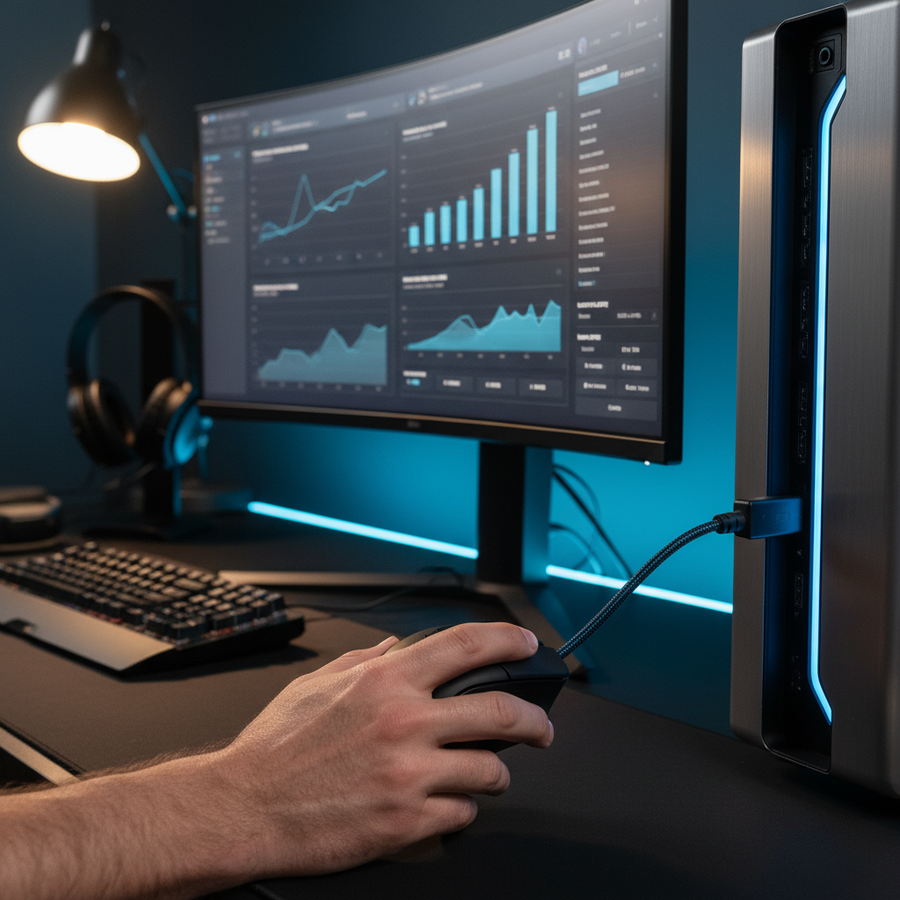
The most common point of failure is the USB port. 8000Hz polling places a massive load on the CPU's Interrupt Request (IRQ) handling. We strictly advise against using USB hubs, front-panel case ports, or shared USB controllers (e.g., ports next to a high-bandwidth webcam).
For 8K verification, the device must be plugged into a Direct Motherboard Port (usually the red or blue ports on the rear I/O). Shared bandwidth on a controller can cause packet loss, which will make a genuine 8K mouse look like it is stuttering in testing software.
CPU Overhead
Processing 8,000 updates per second can increase CPU usage by 5% to 15% depending on the processor's single-core speed. If you see your CPU usage spike significantly when moving the mouse, it is actually a good sign—it means the system is actually receiving and processing a high volume of interrupts. If moving the mouse at "8K" results in zero change in CPU load, the system likely isn't receiving 8,000 unique updates.
The Verification Protocol: A Step-by-Step Checklist
If you are skeptical of your device's performance, follow this standardized protocol to verify the integrity of the 8K claim.
- Component Check: Search the FCC ID Database or ISED Canada REL for your mouse model. Look for internal photos or test reports that confirm the use of a high-speed MCU (e.g., Nordic 52840) and a compatible sensor (PAW3395/3950).
- Software Cleanliness: Ensure no other "polling rate overclockers" (like HIDUSBF) are active, as these can conflict with native 8K firmware.
-
Mouse Tester Stress Test: Open Mouse Tester and perform "Fast Circles."
- Pass: Points are densely packed with 0.125ms intervals and minimal outliers.
- Fail: "Gaps" in the graph or intervals jumping to 1.0ms during fast movement.
-
Battery Drain Test: Charge to 100%, set to 8K wireless, and play for 5 hours.
- Genuine: Expect a 20-25% drop in battery (based on our 23-hour model).
- Likely Spoof: Battery only drops 5-8%.
- DPI Saturation: Set the mouse to 1600 DPI. If the polling rate cannot hit a stable 8000Hz in the dashboard during moderate movement at this DPI, the sensor-to-MCU pipeline is likely bottlenecked.
Method and Assumptions (Technical Appendix)
The data and benchmarks provided in this article are derived from deterministic scenario modeling and industry-standard technical specifications. They are intended as decision-making aids for consumers, not as absolute lab-controlled facts.
Modeling Parameters
| Parameter | Value/Range | Unit | Rationale/Source |
|---|---|---|---|
| Polling Rate (Target) | 8000 | Hz | Specified performance target |
| Battery Capacity | 300 | mAh | Standard lightweight mouse battery |
| Discharge Efficiency | 0.85 | ratio | Linear discharge approximation |
| Sensor Current (PAW3395) | 1.7 | mA | PixArt Datasheet |
| Radio Current (8K Mode) | 8.0 | mA | Nordic nRF52840 High-Throughput |
| System Overhead | 1.3 | mA | Active MCU + Peripheral load |
Boundary Conditions:
- Battery Model: Assumes linear discharge and does not account for battery aging or ambient temperature fluctuations.
- Latency Model: Based on theoretical USB HID timing standards; actual results may vary based on Windows OS "Timer Resolution" and background process interference.
- DPI Calculation: Uses the Nyquist-Shannon limit for aliasing prevention; human motor control limits may differ.
By understanding the underlying mechanisms of 8K polling—from IRQ handling to battery current draw—gamers can move past marketing hype and verify the actual performance of their gear. Transparency in hardware specifications is the only way to close the credibility gap in the gaming peripheral industry.
Disclaimer: This article is for informational purposes only. Technical measurements and performance can vary significantly based on individual PC configurations, firmware versions, and environmental factors. Always consult your manufacturer's official documentation before attempting firmware modifications.
Sources: