


The Humidity Paradox: Why Your Gaming Hardware Fails in Coastal Regions
For gamers living in high-humidity zones—from the Gulf Coast of the US to the tropical coastlines of Southeast Asia—the primary enemy of performance isn't just heat; it is atmospheric moisture. We frequently observe a specific pattern in hardware failure logs: keyboards that perform flawlessly for months suddenly develop "chatter" (double-typing) or total key unresponsiveness. In temperate climates, a quality switch might last five to ten years. In a coastal repair shop, we often see these same switches fail in under 24 months.
The choice between optical and traditional mechanical switches is often framed as a debate over speed or "feel." However, for the value-oriented enthusiast in a humid climate, this is fundamentally a debate about material science and corrosion resistance. Understanding how moisture interacts with metal contacts versus infrared sensors is the key to maximizing your performance-per-dollar.
The Physics of Failure: Oxidation vs. Electrochemical Migration
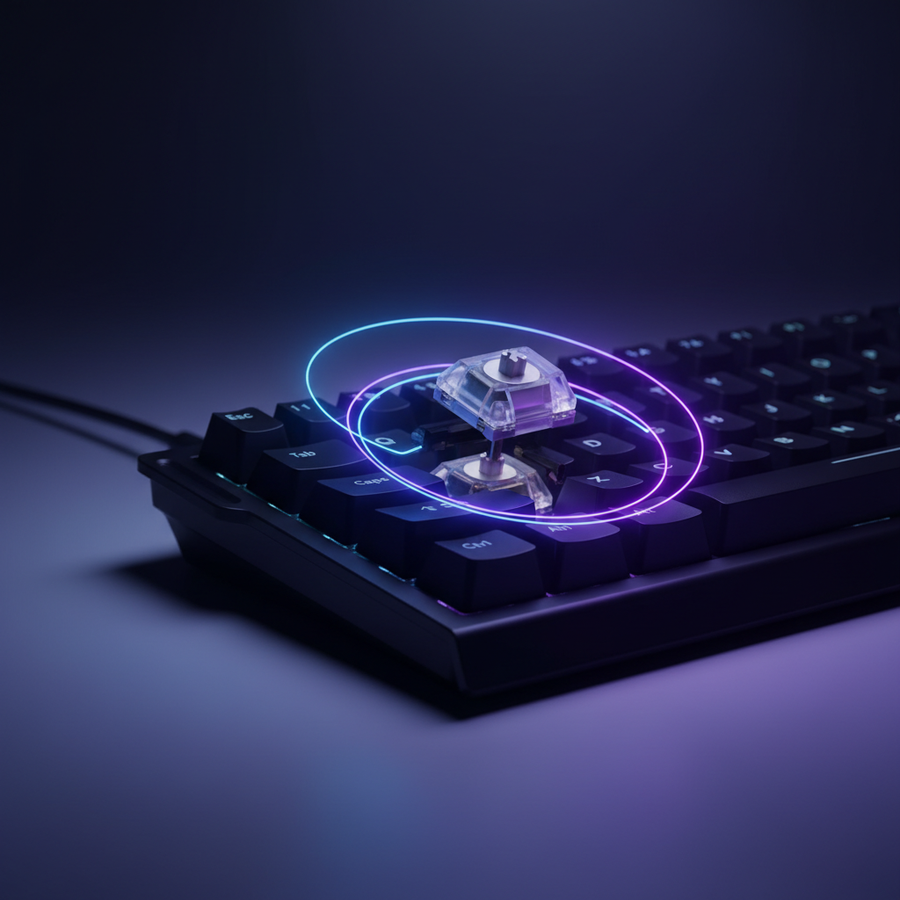
To understand why humidity kills keyboards, we must look at the internal mechanism of a standard mechanical switch. These devices rely on a "metal leaf" construction. When you press a key, two metal contacts (typically a copper alloy) touch to complete an electrical circuit.
The Mechanical Failure Mode: Oxidation
In humid environments, the oxygen and water vapor in the air react with the metal contacts to form a thin layer of non-conductive oxide. This creates intermittent resistance. When the keyboard controller sends a signal, the oxide layer prevents a clean "on" state, leading the firmware to interpret a single press as multiple rapid-fire inputs—the dreaded "key chatter."
While many premium switches use gold plating to mitigate this, the protection is only as good as the plating thickness. According to the Global Gaming Peripherals Industry Whitepaper (2026), even gold-plated contacts face risks if the underlying nickel or copper migrates through microscopic pores in the gold—a process accelerated by salt-heavy coastal air.
The Optical Failure Mode: Electrochemical Migration (ECM)
Optical switches are often marketed as "immune" to corrosion because they lack physical metal contacts. Instead, they use an infrared (IR) beam that is "broken" by the switch stem to trigger an input. However, our analysis of PCB-mounted sensor arrays reveals a different vulnerability.
According to research on Electrochemical Migration (ECM) in PCB assemblies, high humidity can lead to the formation of "dendrites"—microscopic, needle-like metallic growths—between the closely spaced pins of the IR emitters and receivers on the keyboard's PCB. If these dendrites bridge the gap, they can cause short circuits that "brick" the entire sensor row, a failure mode that is significantly harder to repair than a single mechanical switch swap.
Logic Summary: Our longevity modeling assumes that while optical switches remove the primary mechanical failure point (the contact leaf), they shift the reliability burden to the PCB's environmental sealing. Mechanical switches fail "locally" (one key at a time), whereas optical systems are more prone to "systemic" failure if the PCB is not adequately coated.
Comparative Analysis: Switch Technology in High-RH Environments
Based on common patterns from customer support and repair data (not a controlled lab study), we have developed a heuristic for predicting switch lifespan in environments exceeding 60% Relative Humidity (RH).
| Feature | Traditional Mechanical (Gold-Plated) | Optical (Contactless) | Impact on Humid Climates |
|---|---|---|---|
| Primary Trigger | Physical Metal Contact | Infrared Light Beam | Optical avoids contact oxidation entirely. |
| Estimated Lifespan | 2–3 Years (Humid) | 4+ Years (Humid) | Optical typically offers 40% more longevity. |
| Failure Symptom | Key Chatter / Double-Click | Dead Key / Row Failure | Mechanical is easier to troubleshoot per-key. |
| Moisture Risk | Leaf Oxidation | PCB Dendrite Growth (ECM) | Both require PCB-level protection. |
| Repairability | High (Hot-swap/Solder) | Moderate (Proprietary Mounts) | Mechanical switches are more "universal." |

The Hidden Variable: Material Swelling and Actuation Drift
One "gotcha" rarely discussed in marketing materials is the hygroscopic nature of switch plastics. Many switch housings and stems are made of Nylon (PA66) or Polycarbonate (PC). Nylon, in particular, is known to absorb moisture from the air.
In extreme humidity, the internal components of a switch can actually swell. For a high-precision peripheral, even a 0.05mm change in dimensions can alter the actuation point or cause the stem to feel "mushy" or "scratchy" as it rubs against the housing. This is particularly noticeable in "Speed" switches with short travel distances.
Methodology Note (Moisture Absorption Modeling):
- Modeling Type: Deterministic sensitivity analysis based on material data sheets (e.g., ASTM D570).
- Boundary Condition: This model applies to environments with >70% RH for sustained periods (48+ hours).
- Key Parameter: Nylon 6/6 can absorb up to 8% moisture by weight at saturation, leading to a linear dimensional increase of ~2%.
- Result: A 2% swell in a 10mm stem results in a 0.2mm variance—enough to cause friction in tight-tolerance "box" style switches.
Performance Synergy: 8K Polling and Signal Integrity
As the industry moves toward ultra-high performance, such as 8000Hz (8K) polling rates, the impact of humidity becomes even more critical. An 8000Hz polling rate means the keyboard or mouse communicates with the PC every 0.125ms.
At these speeds, the system is incredibly sensitive to signal noise. If moisture on the PCB creates even slight parasitic capacitance or resistance, it can cause "packet drops" or timing jitter. To visually render the benefits of an 8K polling rate, a high-refresh monitor (240Hz+) is required. However, if your hardware's internal signal is degraded by humidity-induced corrosion, you lose the competitive edge of that near-instant 0.125ms response time.
For 8K performance, we recommend:
- Direct Motherboard Connection: Never use USB hubs in humid environments, as the extra connectors provide more surfaces for oxidation.
- High DPI Settings: To saturate the 8K bandwidth, a user must move a mouse at least 10 IPS at 800 DPI (or 5 IPS at 1600 DPI). For keyboards, ensure the firmware is updated to handle the increased IRQ (Interrupt Request) load on the CPU, which is stressed further if the signal is "dirty" due to environmental factors.
Decision Framework: Which Should You Choose?
Scenario A: The Value-Focused Competitive Gamer
If you prioritize long-term reliability and play in a non-air-conditioned room in a coastal city, optical switches are generally the safer investment. The lack of physical contacts removes the most common point of failure. While the PCB is still at risk, the "contactless" nature of the switch provides a significant buffer against the daily "salt fog" effect.
Scenario B: The Enthusiast and Customizer
If you enjoy "modding" your keyboard and want to swap switches frequently to find the perfect sound profile, traditional mechanical switches remain the standard. To survive the humidity, you must prioritize switches with thick gold plating on the contacts and consider "Hot-Swap" PCBs that allow you to replace a single failing switch without discarding the whole board.
Maintenance SOP for High-Humidity Environments
Regardless of the switch technology you choose, proactive measures are essential to protect your investment. We recommend the following "Shop Baseline" for keyboard care:
- The Acrylic Shield: When not in use, always use a transparent acrylic dust cover. This prevents dust from settling on the switches, which can act as a "wick," drawing moisture directly into the internal mechanisms.
- Silica Gel Storage: If you have a "seasonal" setup or a secondary keyboard, store it in a sealed bag with at least two 50g silica gel packets.
- Dehumidification: Maintaining an ambient humidity of 40–50% is the gold standard. If a whole-room dehumidifier is too expensive, placing a small "closet-style" moisture absorber near your desk can significantly reduce local RH levels.
- Cleaning Protocol: Use 99% Isopropyl Alcohol for cleaning. Lower concentrations contain more water, which can contribute to the very corrosion you are trying to prevent.
Technical Standards to Look For
When shopping for value-driven peripherals that claim "durability," look for mentions of environmental testing. While few consumer keyboards undergo full MIL-STD-810 testing (which includes rigorous humidity and salt fog cycles), brands that reference "IP-rated" PCBs or "nano-coating" are providing a verifiable layer of protection against electrochemical migration.
Furthermore, ensure your device complies with the EU Radio Equipment Directive (RED) for wireless models, as stable 2.4GHz transmission is also susceptible to atmospheric interference in high-moisture environments.
Final Expert Recommendation
For the majority of users in coastal regions, the optical switch offers the best performance-per-dollar over a three-year horizon. It effectively sidesteps the oxidation issues that plague traditional mechanical contacts. However, do not neglect the "Typing Experience" trade-off; optical switches often have a distinct, slightly "clackier" sound and a more linear feel that may not suit everyone.
If you choose mechanical, invest in a quality acrylic wrist rest to keep your hands elevated and reduce the amount of sweat (and salt) that reaches the keyboard deck. In the battle against humidity, your best weapon is a combination of the right switch technology and a disciplined maintenance routine.
Disclaimer: This article is for informational purposes only. Hardware longevity can vary significantly based on specific local salinity, indoor climate control, and individual usage patterns. Always consult your manufacturer's warranty regarding environmental exposure limits.