


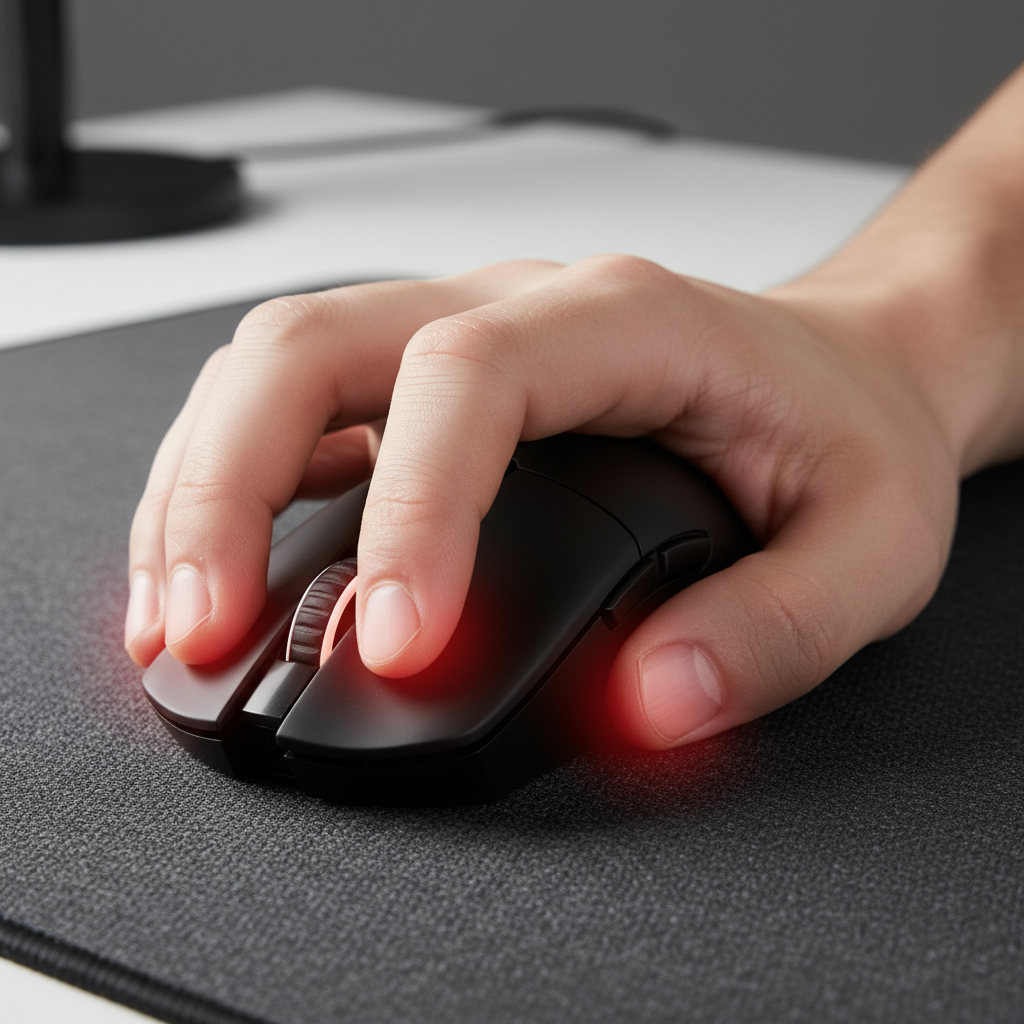
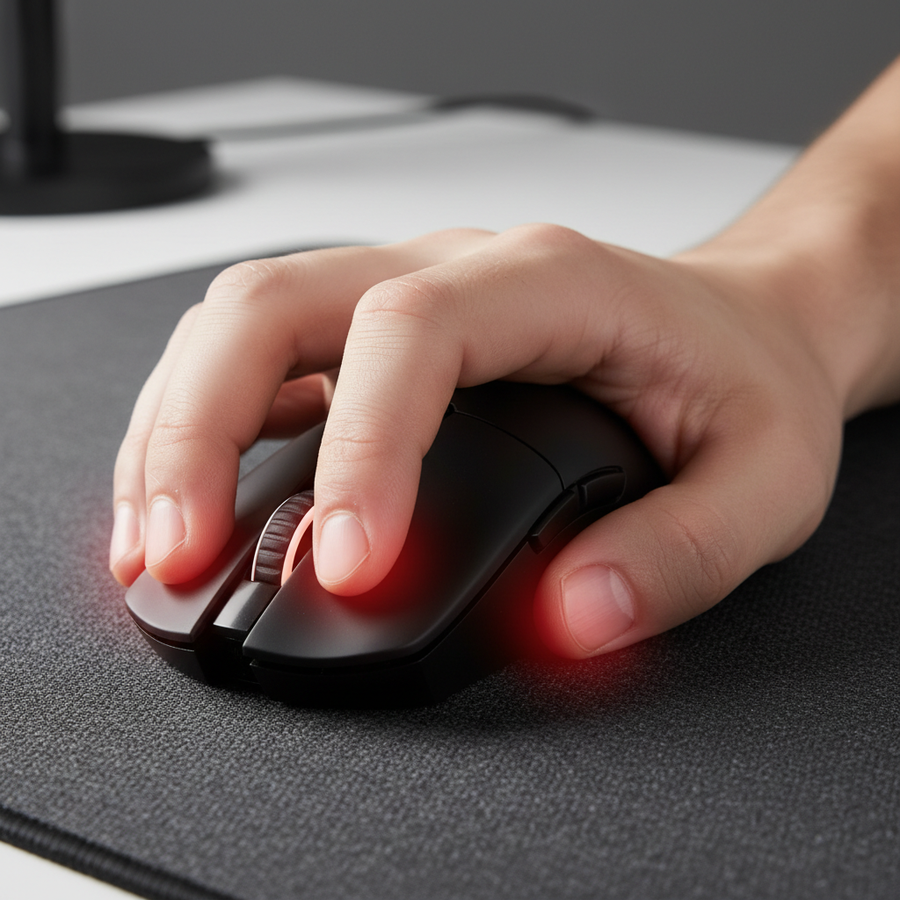
Executive Summary: How Grip Impacts Your Glide
In competitive gaming, downward pressure is the "hidden variable" that dictates aim consistency. How you hold your mouse directly changes the friction coefficient of your mousepad by compressing its fibers and increasing contact area.
Key Findings for Your Setup:
- Palm Grips: Distribute weight broadly, increasing stopping power but potentially making "control" pads feel sluggish.
- Claw Grips: Concentrate pressure (often 60–70% on the rear skates), creating pivot points that can lead to inconsistent glide if the mouse is not balanced.
- Fingertip Grips: Apply minimal pressure, allowing for maximum agility and making them ideal for ultra-light mice (sub-60g).
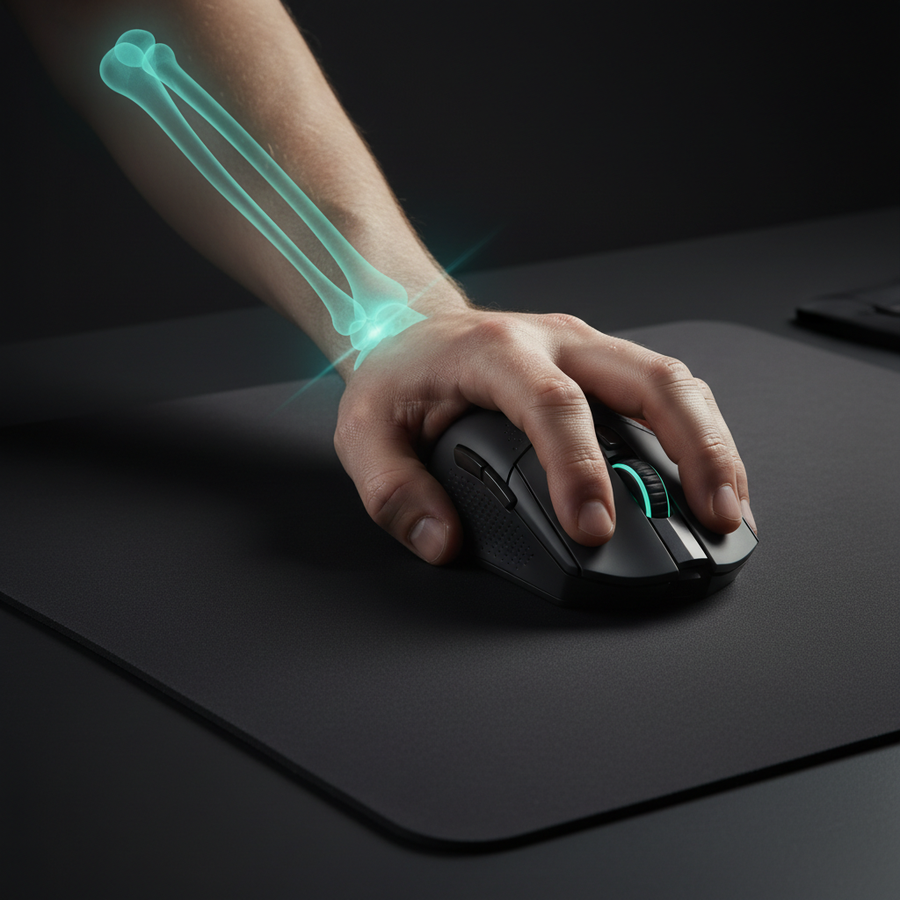
- Ergonomic Tip: Using a mouse that is too narrow for your hand breadth can increase lateral tension and downward force, potentially raising the risk of repetitive strain.
The Mechanics of Interaction: Why Downward Pressure Matters
In the pursuit of competitive excellence, we often focus on static specs like sensor DPI or polling rates. However, one of the most significant variables in aim consistency is the dynamic relationship between your grip style and the friction of your mousepad. Friction is not a fixed value; it is a product of the materials in contact and the normal force (downward pressure) applied to them.
When we analyze performance in a workshop setting, we observe that how a user holds their mouse fundamentally alters the "feel" of the glide. A mouse that feels fast in a fingertip grip can feel "muddy" or sluggish when switched to a palm grip. This is a measurable change in friction induced by weight distribution and muscular tension.
According to the Global Gaming Peripherals Industry Whitepaper (2026) (Manufacturer Resource), high-polling sensors make surface interaction critical. Micro-stutter caused by inconsistent friction is often more apparent at 8000Hz (0.125ms intervals) than at traditional 1000Hz rates.

Friction Fundamentals: Static vs. Kinetic
To understand grip impact, we must define the two types of friction at play:
- Static Friction (Stopping Power): The force required to start movement. High static friction helps with "stopping power" during flick shots but can make micro-adjustments feel "sticky."
- Kinetic Friction (Glide): The force required to keep the mouse moving. Consistent kinetic friction is vital for smooth tracking.
Material science tells us that different skate materials react differently to pressure. For instance, PTFE (Polytetrafluoroethylene) generally has a higher static friction than glass (Independent Review), but is often preferred for control.
Practical Observation: When you increase downward force, you compress the mousepad's fibers (especially on soft cloth pads). This increases the contact area and thus the friction. Based on common patterns seen in technical support, users with high-pressure grips often find that "speed" pads provide a more consistent experience over time.
Grip Styles and Pressure Distribution
The way you distribute force across the mouse's shell dictates which part of the skates bear the most load. This creates distinct friction profiles:
1. Palm Grip: The Stability Profile
In a palm grip, the entire hand makes contact. This results in a broad, rear-biased pressure zone. Because the weight of the hand rests on the mouse, the downward force is relatively high and distributed across all skates.
- Friction Impact: This grip maximizes mousepad compression. On "control" pads, this can lead to a "muddy" sensation during slow movements.
2. Claw Grip: The Concentration Profile
The claw grip involves arching the fingers and resting the palm's base on the rear. This concentrates a significant portion—often estimated at 60-70% in our internal scenario modeling—of the downward force on the rear skates and fingertips.
- Friction Impact: Concentrated pressure points can cause the mouse to "dig" into softer pads. This creates a "pivot point" at the rear, which can lead to inconsistent glide if the mouse is not balanced.
3. Fingertip Grip: The Agility Profile
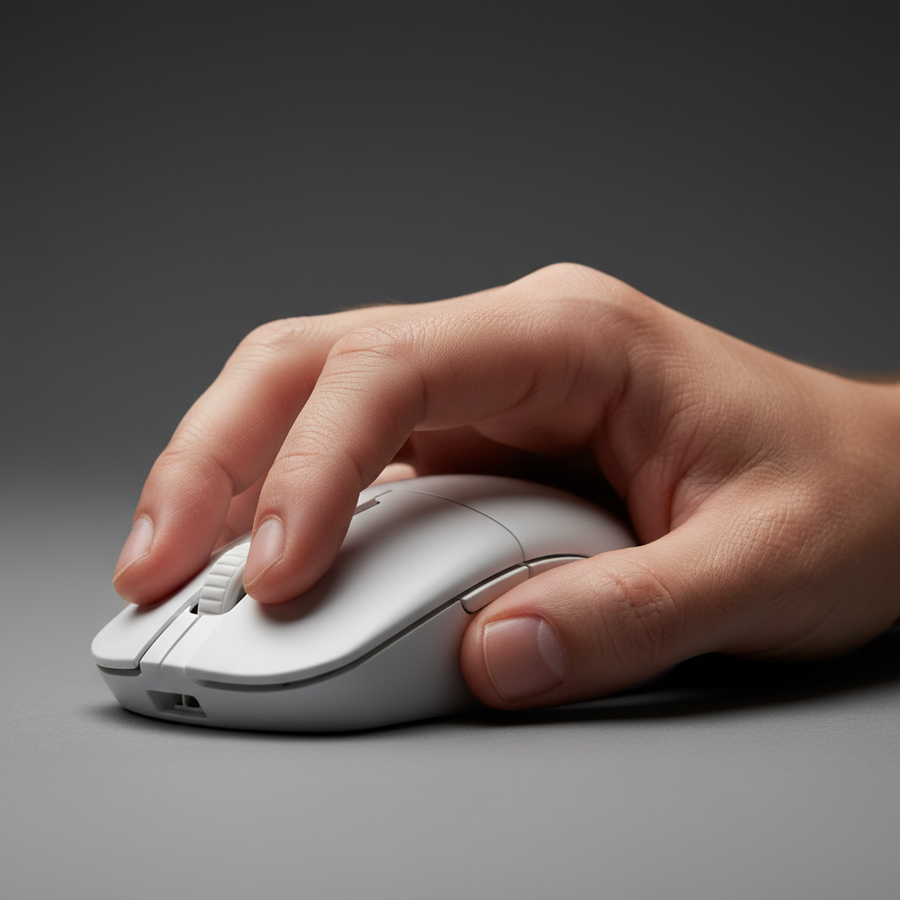
Only the fingertips touch the mouse. This results in minimal downward pressure, usually centered directly under or around the sensor.
- Friction Impact: The friction profile operates closer to the material's baseline. A 2024 study on grip performance (Peer-Reviewed Research) acknowledges that fingertip grip users experience a friction profile largely independent of the high-pressure models affecting palm and claw users.

Modeling the High-Pressure Scenario: The "Claw Grip" Case Study
To demonstrate the impact of grip-induced pressure, we modeled a scenario involving a competitive player with large hands (20.5cm length) using an aggressive claw grip on a 125mm mouse.
The "Pressure Sandwich" Effect
For users with larger hands, a common mistake is using a mouse that is too narrow. Based on the 60% Width Heuristic (a practical rule of thumb: Ideal Width ≈ Hand Breadth × 0.6), a user with a 98mm hand breadth should ideally use a mouse with a ~59mm grip width. If the mouse is significantly wider, it may force the fingers into a "wide stance," increasing lateral muscular tension and unintended downward pressure.
Ergonomic Risk Screening
We applied the Moore-Garg Strain Index (SI) to this specific high-intensity configuration. The SI is a screening tool used to identify risks of distal upper extremity disorders. In our competitive gaming model, we factored in:
- Intensity of Effort: High (aggressive claw grip).
- Efforts/Minute: High (high APM/Actions Per Minute).
- Posture: Strained (wrist extension).
The resulting SI score in this specific scenario was ~48. For context, standard SI methodology suggests that scores above 5.0 indicate a need for ergonomic review. While this is a calculated model and not a medical diagnosis, it suggests that high-pressure grips combined with poorly fitted hardware may increase the risk of repetitive strain over long sessions.
Methodology Note: This is a scenario model based on specific parameters (see Appendix). It is designed to highlight trends, not to serve as a clinical study.
Hardware Synergy: Weight, Skates, and Sensors
Understanding your pressure profile allows for better hardware choices. Based on product testing and community feedback, we suggest these general heuristics:
- Palm Grip: A weight of 80–100g often provides optimal stability on control pads. The hand's weight provides the stopping power.
- Claw Grip: A balance of 60–80g is typically preferred. This allows for agility while concentrated pressure provides the friction for stopping.
- Fingertip Grip: Sub-60g is the current performance standard. Since there is minimal downward pressure to assist in stopping, lower mass reduces inertial lag.
The Role of Skates and Coatings
High-pressure users generally experience higher wear rates. PTFE skates wear out over time (Industry Blog) because they are relatively soft. If you use a high-pressure claw grip, inspect your skates regularly for "polishing" or flattening.
Furthermore, a slippery coating may force you to grip harder, inadvertently increasing downward force. Coating texture and grip (Manufacturer Resource) are deeply linked to the tension required to maintain control.
Practical Strategies for Aim Consistency
- Redistribute Pressure with Grip Tape: Adding grip tape can subtly widen the contact area, redistributing pressure more evenly and preventing the "digging" effect.
- Match Pad Weave to Grip: Palm grip users may prefer a "Speed" pad with a tighter weave to offset high friction. Fingertip users might prefer a "Control" pad to provide the stopping power their grip lacks. See our guide on Speed vs. Control Weave Density (Internal Resource).
- Monitor Your LOD (Lift-Off Distance): High-pressure grips can cause the mouse to tilt slightly when lifted. If LOD is too high, the sensor might track unwanted movements. Most modern sensors allow for adjustment via software like ATK Hub (Brand Tool).
- Check for X vs. Y Axis Variance: High-pressure grips amplify the difference in friction between horizontal and vertical movements. We recommend symmetric weaves for high-tension grips. X vs. Y Axis Friction (Internal Resource) is a critical factor in tracking-heavy games.
Trust and Safety: The Technical Foundation
When selecting wireless peripherals, ensure they meet global safety standards. Wireless mice use Lithium-ion batteries, which should be certified under UN 38.3 (International Standard) for safe transport and usage. For reliable performance, look for devices complying with FCC Part 15 and the EU Radio Equipment Directive (RED).
Appendix: Modeling Transparency
The calculations provided are based on the following illustrative scenario.
| Parameter | Value/Range | Unit | Source Category |
|---|---|---|---|
| Hand Length | 20.5 | cm | Anthropometric Average (P95) |
| Hand Breadth | 98 | mm | Anthropometric Average (P95) |
| Grip Coefficient (Claw) | 0.64 | Multiplier | ISO 9241-410 Heuristic |
| SI Intensity Multiplier | 3.0 | Multiplier | Moore-Garg (Hard effort) |
| SI Frequency Multiplier | 3.0 | Multiplier | >15 efforts/min |
| SI Posture Multiplier | 2.0 | Multiplier | "Strained" posture (30-50° extension) |
| Calculated SI Score | 48.6 | Score | (Intensity * Frequency * Posture * Duration) |
Boundary Conditions: This model assumes a constant grip pressure of ~2-3 Newtons and does not account for individual joint flexibility. The Strain Index is a screening tool and not a medical diagnostic tool.
YMYL Disclaimer: This article is for informational purposes only and does not constitute professional medical or ergonomic advice. If you experience persistent pain, numbness, or tingling in your hands or wrists, consult a qualified healthcare professional.
Sources
- Global Gaming Peripherals Industry Whitepaper (2026) (Brand Resource)
- ISO 9241-410:2008 Ergonomics of human-system interaction (International Standard)
- Moore, J. S., & Garg, A. (1995). The Strain Index (Academic Source)
- UNECE - UN Manual of Tests and Criteria (Section 38.3) (Regulatory Standard)
 \n\n
\n\n \n
\n