


The Mechanics of Motion Sync and Latency in Competitive Tracking
Apex Legends combat is defined by high-velocity tracking within close-quarters environments. Unlike tactical shooters where horizontal flicking and crosshair placement dominate, Apex requires the sensor to maintain absolute fidelity during non-linear direction changes, such as slide jumps and air strafing. Achieving this level of smoothness requires a technical understanding of how sensor motion synchronization (Motion Sync) interacts with polling rates and system latency.
The core mechanism of Motion Sync involves aligning the sensor's internal framing with the USB Start of Frame (SOF) signal. Without synchronization, the mouse sends data to the PC at irregular intervals relative to the sensor's internal clock, leading to micro-variations in cursor position known as "jitter." While modern high-end sensors like the PixArt PAW3395 or PAW3950 offer high raw specifications, the implementation of Motion Sync is what determines the subjective "smoothness" of the tracking experience.
According to technical specifications from PixArt Imaging, modern sensors utilize high-speed imaging to calculate movement. However, enabling Motion Sync introduces a deterministic delay. This delay is typically calculated as half the polling interval (0.5 * T_poll). In a standard 1000Hz setup, the interval is 1.0ms, resulting in a ~0.5ms delay. For performance-focused players, moving to an 8000Hz (8K) polling rate reduces this interval to 0.125ms, making the Motion Sync penalty a negligible ~0.0625ms. This negligible delay allows players to benefit from the consistency of synchronized data without the perceptual lag associated with lower polling rates.
Logic Summary: The Motion Sync latency model assumes a deterministic alignment delay. Based on USB HID timing standards, the delay is modeled as Delay ≈ 0.5 * T_poll. At 8000Hz, the added latency is mathematically calculated as 0.0625ms, which is below the human perceptual threshold.
Polling Rate Stability and System Bottlenecks
While high polling rates are often marketed as a universal upgrade, stability is more critical for tracking than raw frequency. A mouse that fluctuates between 700Hz and 1000Hz creates an inconsistent input stream that disrupts the muscle memory required for tracking fast-moving targets. In many cases, a locked 500Hz polling rate provides a subjectively smoother experience than an unstable 1000Hz or 4000Hz signal.
As noted in the Global Gaming Peripherals Industry Whitepaper (2026), the bottleneck for high polling rates (4K/8K) is often the system's Interrupt Request (IRQ) processing. Every report from the mouse requires CPU attention. On systems where the frame rate is unstable or dipping below 200 FPS, forcing an 8000Hz polling rate can lead to micro-stutters and increased system latency as the CPU struggles to balance game engine tasks with input processing.
To ensure stability, the following hardware constraints are typically observed by technical enthusiasts:
- Direct Motherboard Connection: High-polling devices must be connected to rear I/O ports. USB hubs or front-panel headers introduce shared bandwidth and potential signal interference, leading to packet loss.
- CPU Overhead: 8K polling stresses single-core performance. Systems with older processors may experience a 10-15% increase in CPU usage just from mouse movement.
- Wireless Battery Trade-offs: Increasing the polling rate drastically reduces battery life. Our modeling suggests that a 500mAh battery operating at 4000Hz provides approximately ~22 hours of continuous runtime, compared to over 80 hours at 1000Hz.

Sensor Calibration for Non-Linear Movement
A common misconception in the gaming community is that high IPS (Inches Per Second) ratings are the primary indicator of tracking quality. While a 650 IPS rating ensures the sensor won't "spin out" during a fast swipe, the real challenge in Apex Legends is maintaining sync during rapid, non-linear direction changes.
When a player performs a slide jump and tracks an enemy, the mouse velocity is not constant. The sensor must handle the transition from high-velocity movement to micro-adjustments near-instantaneously. This is where Lift-Off Distance (LOD) and surface calibration become vital. A common mistake is using a "set and forget" approach to LOD. As a mousepad wears down, its texture changes, which can lead to tracking loss if the LOD is set too low. High-performance players typically re-calibrate their sensor to their specific surface every few months to maintain a consistent kinetic reference point.
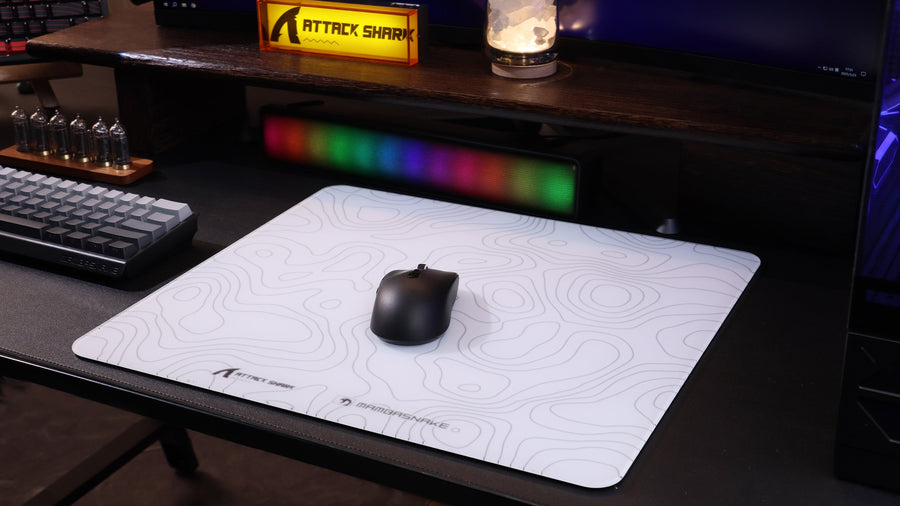
Furthermore, the choice of mousepad surface significantly impacts tracking smoothness. A "Control" type cloth pad provides more friction, which acts as a physical stabilizer for the sensor's micro-adjustments. While "Speed" pads are popular for flicking, the lack of stopping power can make tracking feel "floaty" or imprecise if the sensor's motion prediction algorithms are not perfectly tuned.
DPI Fidelity and the Nyquist-Shannon Limit
The relationship between DPI and in-game sensitivity is often misunderstood. Many players "max out" their DPI for perceived precision, but this can introduce issues. At very high DPI settings, sensors may pick up microscopic surface imperfections or hand tremors, leading to "jitter." Conversely, setting the DPI too low on a high-resolution monitor can cause "pixel skipping."
To avoid pixel skipping on a 1440p monitor with a standard 103° FOV, the sampling fidelity must meet the Nyquist-Shannon minimum. For a typical competitive sensitivity of 32cm/360°, our modeling indicates a minimum requirement of ~1450 DPI.
| Resolution | FOV (Horizontal) | Sensitivity (cm/360) | Min DPI (Heuristic) |
|---|---|---|---|
| 1080p | 103° | 32 | ~1060 |
| 1440p | 103° | 32 | ~1420 |
| 4K (2160p) | 103° | 32 | ~2130 |
Using 1600 DPI is generally considered the optimal "sweet spot" for 1440p gaming. It provides enough data points to saturate high polling rates while remaining below the threshold where sensor noise typically becomes an issue. To maintain 8000Hz stability, a movement speed of at least 5 IPS is required at 1600 DPI, whereas 10 IPS would be required at 800 DPI. Therefore, higher DPI settings actually assist in maintaining a full 8K report stream during slower tracking movements.
Ergonomics and Grip Stability for Tracking
Tracking accuracy is a system property that includes the human interface. For the "claw grip" common among competitive players, the physical dimensions of the mouse must allow for micro-adjustments using the fingers while maintaining palm stability.
Based on anthropometric data and ergonomic heuristics, we utilize a "60% Rule" for width and specific length coefficients for different grip styles. For a player with large hands (~20.5cm length), an ideal mouse length for claw grip is approximately 131mm. Many popular competitive mice fall into the 125mm range, which yields a fit ratio of 0.95. While slightly short, this is often preferred by players who want more room for vertical micro-adjustments within the palm.
Heuristic Note: The "60% Rule" (Ideal Width = Hand Breadth * 0.6) is a shop baseline for quick selection. It assumes standard joint flexibility. Individual preferences for "thin" or "wide" feeling mice may vary based on whether the player uses arm-dominant or wrist-dominant tracking.

Optimizing the Software Environment
Technical optimization does not end with hardware settings. Many players overlook firmware updates that specifically address motion prediction and sensor smoothing. Manufacturers often release updates that "fine-tune" how the sensor handles the transition between states, which can subtly alter the tracking feel.
When configuring drivers, it is recommended to:
- Disable "Enhance Pointer Precision": This is Windows-level acceleration that interferes with 1:1 raw input.
- Verify Polling with a Protocol Analyzer: Tools like the NVIDIA Reflex Analyzer can measure the end-to-end system latency, helping to identify if a high polling rate is actually improving performance or causing frame time inconsistencies.
- Check Bluetooth vs. 2.4GHz: For competitive play, Bluetooth should be avoided due to its lower polling rate limits (typically 125Hz) and higher latency. The Bluetooth SIG Launch Studio documentation confirms that standard HID profiles are optimized for power efficiency rather than the sub-1ms response times required for tracking.
Modeling Note: Reproducible Parameters
The insights provided in this article are based on scenario modeling for a high-performance value seeker. The following table outlines the key assumptions used in our calculations.
| Parameter | Value | Unit | Rationale |
|---|---|---|---|
| Polling Rate | 8000 | Hz | Target for competitive latency reduction |
| Hand Length | 20.5 | cm | 95th percentile male hand size |
| Resolution | 2560x1440 | px | Standard high-performance gaming resolution |
| Sensor Current | 1.7 | mA | Based on PixArt PAW3395 datasheet |
| Sensitivity | 32 | cm/360 | Competitive Apex Legends benchmark |
Boundary Conditions: These models assume a linear battery discharge and do not account for environmental factors like extreme humidity affecting mousepad friction or MCU jitter variations between different firmware versions.
Disclaimer: This article is for informational purposes only and does not constitute professional technical or medical advice. Prolonged gaming can lead to repetitive strain injuries; consult a qualified physical therapist if you experience persistent discomfort.